The 2027 assembly elections will do more than choose state governments. They will also reshape the electoral college that elects the next President of India. President Droupadi Murmu took office on 25 July 2022, and her five-year term ends on 24 July 2027. The Constitution requires the election to be completed before then (Article 62).
The short version
- The President is elected indirectly, by elected MPs and elected MLAs (Article 54).
- Votes are weighted: an MLA’s vote is worth more in a populous state.
- Voting is by secret ballot, using the single transferable vote.
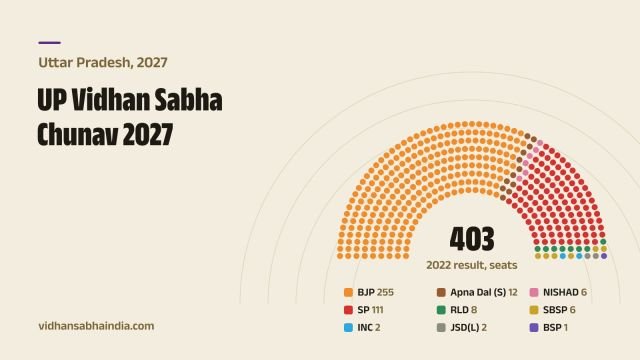
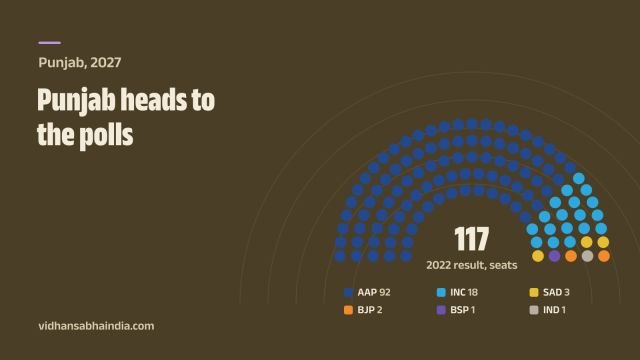
- Five assemblies — UP, Punjab, Uttarakhand, Goa and Manipur — will be newly elected before the vote.
Who votes
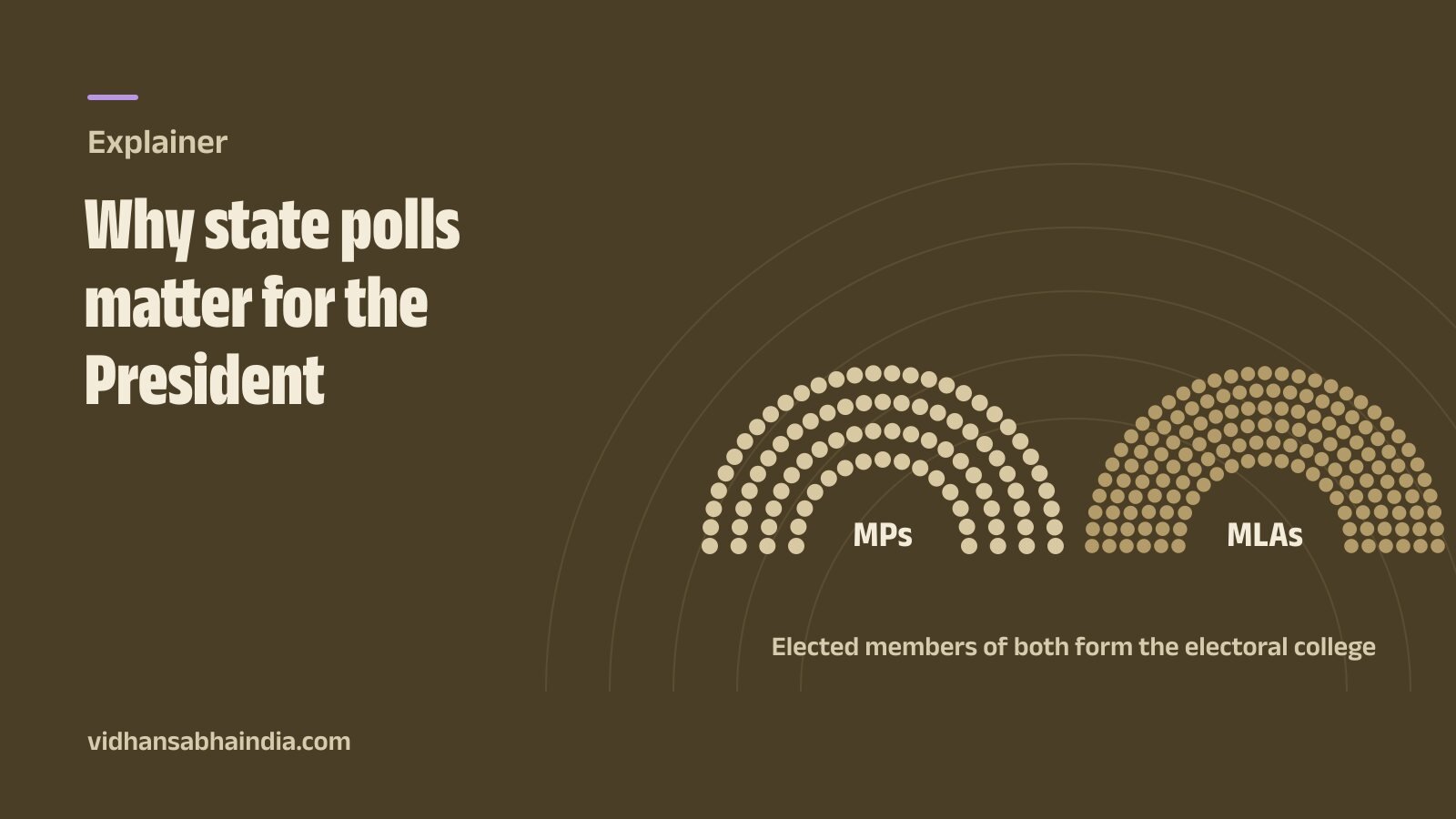
The electoral college has two parts:
- Elected members of both houses of Parliament — Lok Sabha and Rajya Sabha. Nominated members do not vote.
- Elected members of every state legislative assembly, including Delhi and Puducherry, which were added by the 70th Amendment in 1992. Members of legislative councils (Vidhan Parishads) do not vote, and nor do nominated MLAs.
Why one MLA’s vote is worth more than another’s
Article 55 aims for two kinds of fairness: between states of different sizes, and between the states as a whole and the Union. It does this by giving each vote a value.
Value of an MLA’s vote
Formula: population of the state ÷ (number of elected MLAs × 1,000). By constitutional amendment, the population used is that of the 1971 Census, a freeze that continues until the first census after 2026 is published.
For Uttar Pradesh: 8,38,49,905 ÷ (403 × 1,000) ≈ 208. That is the highest value of any state. Sikkim’s MLAs have the lowest, at 7.
| State | MLAs | Value of each vote | Total for the state |
|---|---|---|---|
| Uttar Pradesh | 403 | 208 | 83,824 |
| Gujarat | 182 | 147 | 26,754 |
| Punjab | 117 | 116 | 13,572 |
| Uttarakhand | 70 | 64 | 4,480 |
| Himachal Pradesh | 68 | 51 | 3,468 |
| Goa | 40 | 20 | 800 |
| Manipur | 60 | 18 | 1,080 |
Uttar Pradesh alone contributes more than 83,000 vote-value points — by far the largest share of any state. That is why the UP result is watched for its national as well as its state consequences.
Value of an MP’s vote
The combined value of all MLA votes across the country is divided by the number of elected MPs. This makes the total for Parliament roughly equal to the total for the states. In the 2022 election, each MP’s vote was worth 700. The figure is recalculated for each election, so it will change if the total of MLA votes changes — for example, because the Jammu and Kashmir assembly, which was not in existence in 2022, now has elected members again.
How the votes are cast and counted
- The Election Commission conducts the election. Nominations need 50 proposers and 50 seconders from among the electors.
- MPs usually vote in Parliament House and MLAs in their state assembly building.
- Each elector marks preferences — 1, 2, 3 and so on — against the candidates. This is the single transferable vote.
- To win, a candidate needs a quota: more than half of the total value of valid votes.
- If no one reaches the quota on first preferences, the lowest candidate is eliminated and their ballots transfer to the next preference, until someone crosses the line.
The ballot is secret, and parties cannot issue a binding whip, so the anti-defection law does not apply to the presidential vote.
What changes in 2027
- The five early-2027 states — Uttar Pradesh, Punjab, Uttarakhand, Goa and Manipur — will vote for President with their newly elected MLAs.
- Gujarat and Himachal Pradesh vote for their own assemblies only after the presidential election, so their 2022 MLAs will cast the presidential ballot.
- The Vice-President is elected separately, by MPs alone.
No candidates have been announced. We will publish the schedule when the Election Commission notifies it.