Uttar Pradesh sends more members to its legislative assembly than any other state — 403 directly elected MLAs. The 18th Vidhan Sabha, elected in 2022, completes its term on 22 May 2027, and a new house must be in place by then. Polling is widely expected in the first months of 2027, but the Election Commission of India has not yet announced a schedule.
UP election 2027 at a glance
- Seats: 403 (majority: 202)
- Term of current assembly ends: 22 May 2027
- Registered electors: 13,39,84,792 in the final roll of 10 April 2026
- Chief Minister: Yogi Adityanath (BJP), since March 2017
- Election dates: not yet announced
How UP voted in 2022
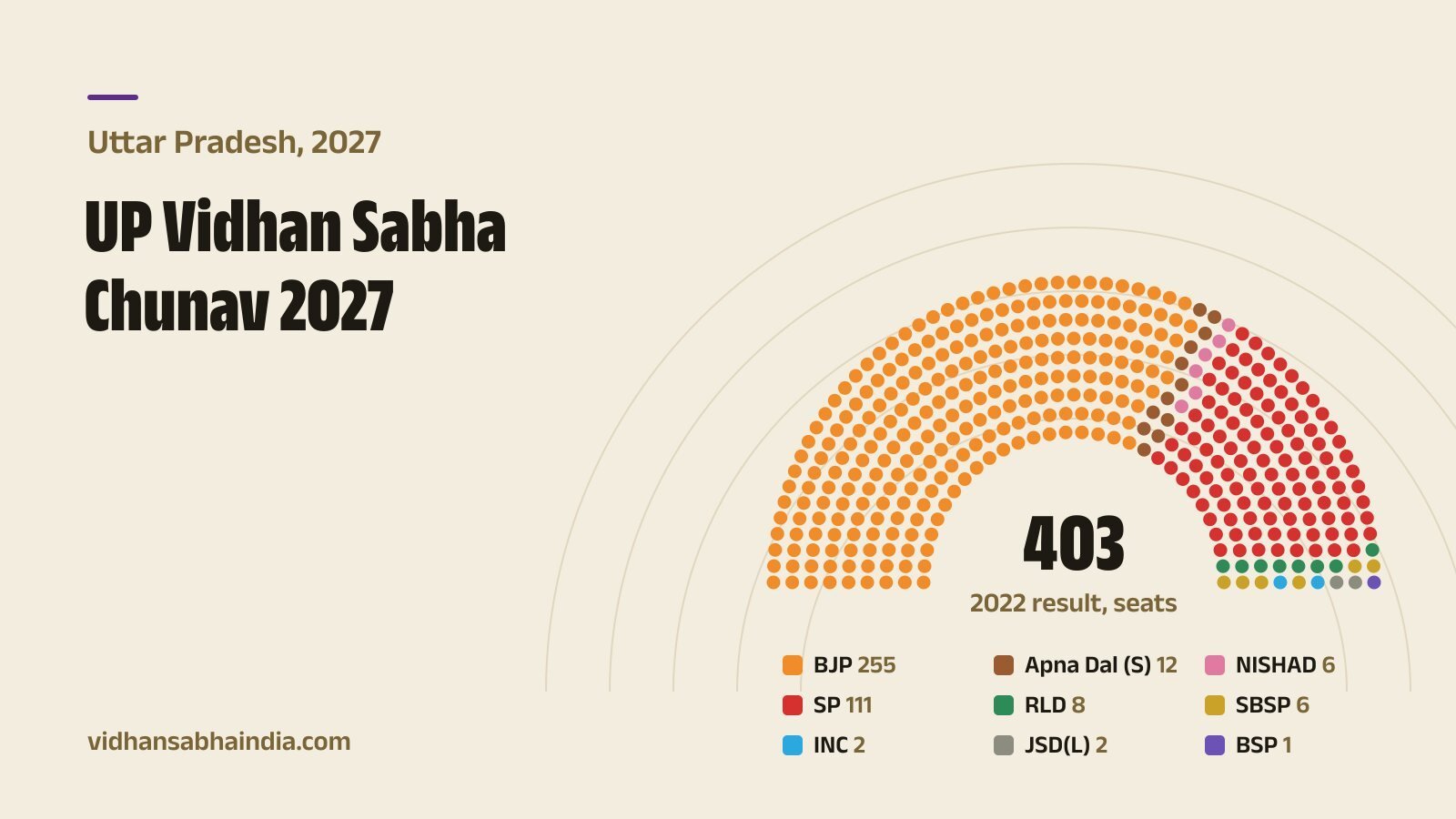
The 2022 election was held in seven phases between 10 February and 7 March, and votes were counted on 10 March. The BJP-led alliance returned to power with a reduced but comfortable majority, and Yogi Adityanath became the first Chief Minister in more than three decades to be voted back after completing a full five-year term.
| Party | Alliance in 2022 | Seats won |
|---|---|---|
| Bharatiya Janata Party (BJP) | NDA | 255 |
| Apna Dal (Soneylal) | NDA | 12 |
| NISHAD Party | NDA | 6 |
| Samajwadi Party (SP) | SP alliance | 111 |
| Rashtriya Lok Dal (RLD) | SP alliance | 8 |
| Suheldev Bharatiya Samaj Party (SBSP) | SP alliance | 6 |
| Indian National Congress | — | 2 |
| Jansatta Dal (Loktantrik) | — | 2 |
| Bahujan Samaj Party (BSP) | — | 1 |
| Total | 403 |
The NDA alliance won 273 seats and the SP-led alliance 125. The Samajwadi Party more than doubled its 2017 tally of 47, while the BJP fell from 312. The BSP, which governed the state on its own from 2007 to 2012, won a single seat.
Alliances have shifted since 2022. Both the RLD and the SBSP later moved to the NDA. Seat-sharing for 2027 has not been settled by either side, so the 2022 alliance labels above describe the last election, not the next one.
A new voter list
Uttar Pradesh is going into this election with an electoral roll that has been rebuilt from the ground up. Under the Special Intensive Revision (SIR), Booth Level Officers verified electors house by house through 2025 and early 2026.
- The draft roll published on 6 January 2026 listed 12,55,56,025 electors.
- After claims and objections, the final roll published on 10 April 2026 listed 13,39,84,792 electors — 84,28,767 more than the draft.
- The final roll has 834 women for every 1,000 men.
- Young voters aged 18–19 number 17,63,360, or 1.32% of the electorate.
The figures were presented in Lucknow by the state’s Chief Electoral Officer, Navdeep Rinwa.
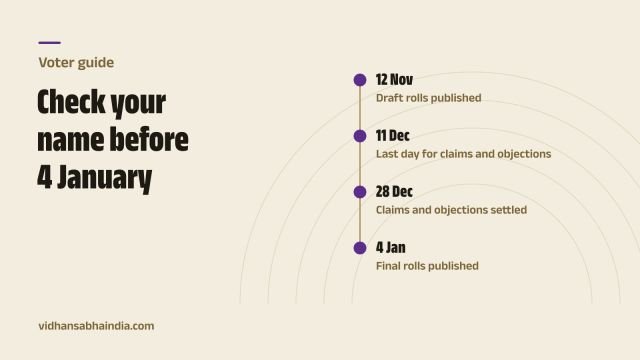
A lighter update is now under way. The Special Summary Revision with a qualifying date of 1 January 2027 will publish draft rolls on 12 November, accept claims until 11 December and release the final roll on 4 January 2027. If you are a UP voter, check your entry now.
What the Election Commission has ordered
On 27 October the Commission asked Uttar Pradesh and four other poll-bound states to move officers out of their home districts and to transfer those who have served three years or more in a district within the last four years. For UP, the cut-off for counting that three-year period is 31 May 2027, reflecting its later term-end date. The order covers DMs, SDMs, tehsildars, divisional and municipal commissioners, and police officers from IGs and DIGs down to SPs.
When could UP vote?
The law lets the Commission hold the election at any point in the last six months of the assembly’s term — for UP, from late November 2026 onwards. In 2022, UP was grouped with Punjab, Uttarakhand, Goa and Manipur, and voting was spread over seven phases to allow central forces to move across 75 districts.
Two practical factors will weigh on this year’s calendar:
- Board exams. UP Board high school and intermediate exams usually begin in February, and schools are used as polling stations. Reports suggest the board could adjust its timetable if polling falls in February.
- The Census. The population-enumeration phase of the national Census begins in February 2027 and uses many of the same government staff. Reports have suggested that polls could be brought forward to avoid a clash.
Neither has been confirmed. The schedule — and the Model Code of Conduct — will begin only when the Commission makes its announcement.
How the UP assembly is made up
Uttar Pradesh is one of six states with a bicameral legislature. Alongside the 403-member Vidhan Sabha, it has a 100-member Vidhan Parishad (legislative council), whose members are chosen by MLAs, local bodies, graduates and teachers, or nominated by the Governor. Only the Vidhan Sabha is directly elected, and only it decides who forms the government.
The house is presided over by Speaker Satish Mahana, elected in 2022. The Leader of the Opposition comes from the Samajwadi Party, the largest opposition party.
Why UP’s result reaches beyond Lucknow
- Rajya Sabha: UP elects 31 members of the Rajya Sabha, chosen by its MLAs.
- The President: each UP MLA’s vote in the presidential election is worth 208 — the highest of any state. The next presidential election is due by July 2027. Read our explainer.
- Lok Sabha: with 80 Lok Sabha seats, UP is the largest prize in national elections, and its assembly results are read as a signal for 2029.
What to watch
- The Election Commission’s schedule and the number of phases.
- Seat-sharing within the NDA and within the opposition, including whether the SP and Congress contest together as they did in the 2024 Lok Sabha election.
- Candidate lists, including in constituencies reserved for Scheduled Castes and Scheduled Tribes.
- Turnout among women and first-time voters on the new roll.
Follow all our coverage in UP Election 2027. Once counting begins, results will appear in UP Election Result.