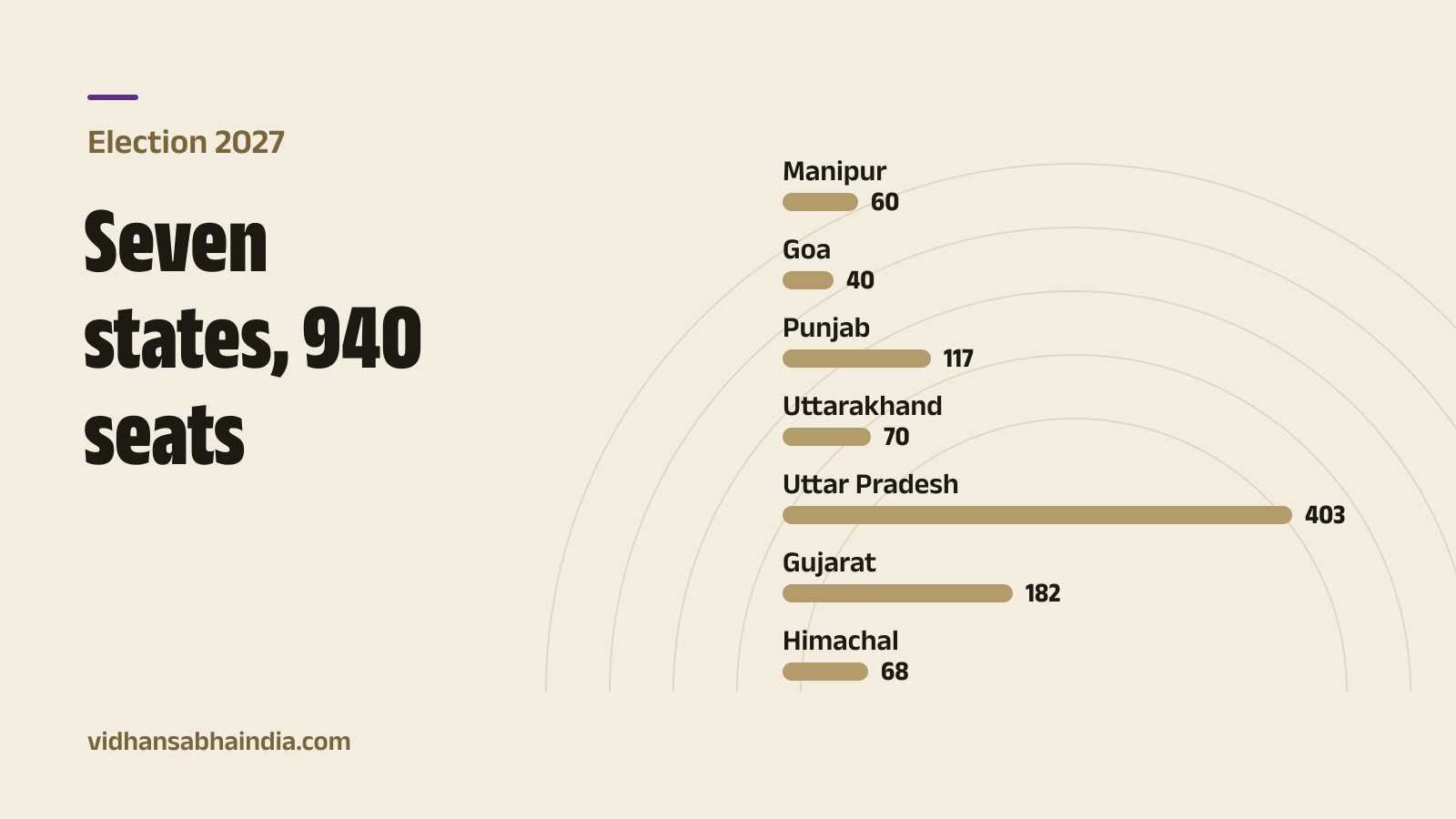
India’s next big round of state elections has already begun on paper. Seven legislative assemblies — together holding 940 seats — reach the end of their five-year terms between March 2027 and early 2028. Five of them, including the 403-member Uttar Pradesh Vidhan Sabha, must have new houses in place by the spring.
The Election Commission of India (ECI) has not announced polling dates. But the machinery is moving: electoral rolls are being revised, officials are being moved out of their home districts, and commission teams have started visiting state capitals.
At a glance
- Early 2027: Uttar Pradesh, Punjab, Uttarakhand, Goa and Manipur — 690 seats.
- Late 2027: Gujarat and Himachal Pradesh — 250 seats.
- Earliest deadline: Manipur’s assembly term ends on 13 March 2027.
- Latest of the five: Uttar Pradesh, on 22 May 2027.
- Dates: not yet announced by the Election Commission.
The seven states and their deadlines
A state assembly lasts five years from the date of its first meeting, unless it is dissolved earlier (Article 172 of the Constitution). The election has to be completed before that date so that a new house can be constituted. The term-end dates below are those reported for each assembly; the majority mark is half the house plus one.
| State | Seats | Majority | Term ends | Last election |
|---|---|---|---|---|
| Manipur | 60 | 31 | 13 March 2027 | Feb–Mar 2022 (two phases) |
| Goa | 40 | 21 | 14 March 2027 | 14 Feb 2022 |
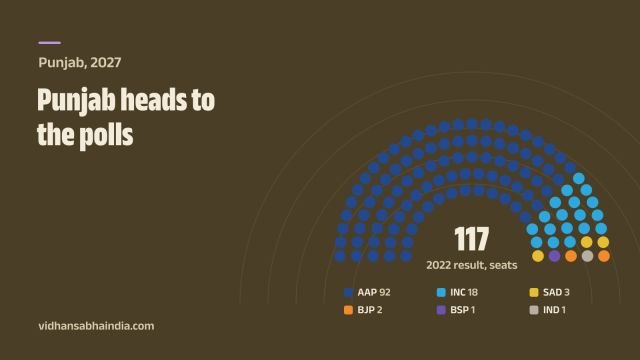
| Punjab | 117 | 59 | 16 March 2027 | 20 Feb 2022 |
| Uttarakhand | 70 | 36 | March 2027 | 14 Feb 2022 |
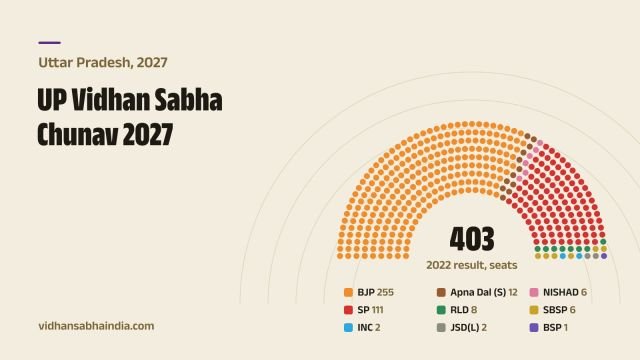
| Uttar Pradesh | 403 | 202 | 22 May 2027 | Feb–Mar 2022 (seven phases) |
| Gujarat | 182 | 92 | Late 2027 / early 2028 | Dec 2022 (two phases) |
| Himachal Pradesh | 68 | 35 | Late 2027 / early 2028 | 12 Nov 2022 |
In 2022 the first five states voted together. Counting for all of them took place on a single day, 10 March 2022. The Commission often groups states whose terms end close together, and the same pattern is widely expected this time.
Who governs each state now
- Uttar Pradesh: Yogi Adityanath (BJP), Chief Minister since 2017 and re-elected in 2022.
- Punjab: Bhagwant Mann (AAP), Chief Minister since March 2022.
- Uttarakhand: Pushkar Singh Dhami (BJP), Chief Minister since July 2021.
- Goa: Pramod Sawant (BJP), Chief Minister since March 2019.
- Manipur: Yumnam Khemchand Singh (BJP), Chief Minister since 4 February 2026, after nearly a year of President’s Rule.
- Gujarat: Bhupendra Patel (BJP), Chief Minister since September 2021.
- Himachal Pradesh: Sukhvinder Singh Sukhu (Congress), Chief Minister since December 2022.
What the Election Commission has done so far
Revising the voter lists
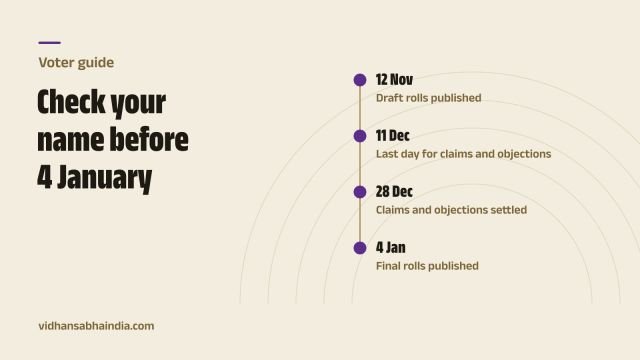
In October the Commission ordered a Special Summary Revision (SSR) of electoral rolls in 17 states and union territories, including all five early-2027 states. Anyone who turns 18 on or before 1 January 2027 can be included. The draft rolls are due on 12 November, claims and objections can be filed until 11 December, and the final rolls are scheduled for 4 January 2027. Our voter guide explains how to check and correct your entry.
Uttar Pradesh had already been through a far more intensive exercise. After a Special Intensive Revision (SIR), the state’s final roll, published on 10 April 2026, listed about 13.4 crore electors.
Moving officials
On 27 October the Commission told the five states to transfer officers who are posted in their home districts, or who have served three years or more in a district during the last four years. The order covers district magistrates, sub-divisional magistrates, tehsildars, divisional and municipal commissioners and senior police officers. Transfers of officials working on the roll revision are to happen only after the final rolls are published.
This is a routine step before every major election. It is meant to stop officials with long local ties from overseeing polls in their own areas.
Visiting the states
Senior commission officials, led by deputy election commissioners, visited Dehradun on 13 October to assess Uttarakhand’s preparations with the state administration and police. A visit by the full Commission is usually the last step before dates are announced.
When will the dates be announced?
Nobody outside the Commission knows yet. Election law allows the Commission to hold the poll at any time within the last six months of an assembly’s term. In 2022 the schedule for the five states was announced in early January, about five weeks before the first phase of voting.
One new factor is the national Census. The population-enumeration phase is due to begin in February 2027, and it draws on the same teachers and government staff who run polling booths. Reports earlier this year said the Commission could advance polling in some states by a few weeks to avoid a clash. The Commission has not announced any such decision.
Model Code of Conduct. The code comes into force the moment the schedule is announced. From then on, governments cannot announce new schemes or projects, and transfers of election officials need the Commission’s approval.
The late-2027 pair: Gujarat and Himachal Pradesh
Gujarat and Himachal Pradesh voted in November–December 2022 and are expected to vote again in late 2027. Himachal Pradesh has not yet been scheduled for the roll revision; the Commission has said it will issue separate notices for states such as Himachal and Jammu and Kashmir, taking winter weather into account. We look at both states in detail in our explainer on the late-2027 pair.
Why these elections matter beyond the states
State results feed directly into national politics. MLAs elect members of the Rajya Sabha, and they form part of the electoral college that chooses the President. President Droupadi Murmu’s term ends in July 2027, so the composition of these assemblies — especially Uttar Pradesh, where each MLA’s vote carries the highest value of any state — will matter in that contest too. Here is how that works.
Read our state-by-state guides
- Uttar Pradesh: 403 seats, 13.39 crore voters
- Punjab: the 117-seat assembly before the vote
- Uttarakhand: 70 seats and a broken pattern
- Goa: 40 seats and shifting majorities
- Manipur: from President’s Rule to the polls
We will update this page when the Election Commission announces the schedule.