A Vidhan Sabha, or Legislative Assembly, is the elected law-making house of an Indian state. It passes the state’s laws, approves its budget and decides who governs: the Chief Minister holds office only as long as he or she keeps the support of a majority of its members.
India has 31 legislative assemblies — one in each of the 28 states, plus Delhi, Jammu and Kashmir and Puducherry. Together they have 4,123 directly elected seats.
Quick facts
- Constitutional basis: Part VI, Articles 168 to 212.
- Size: between 60 and 500 members, with exceptions for small states.
- Term: five years from the first meeting, unless dissolved earlier.
- Minimum age to be an MLA: 25 years.
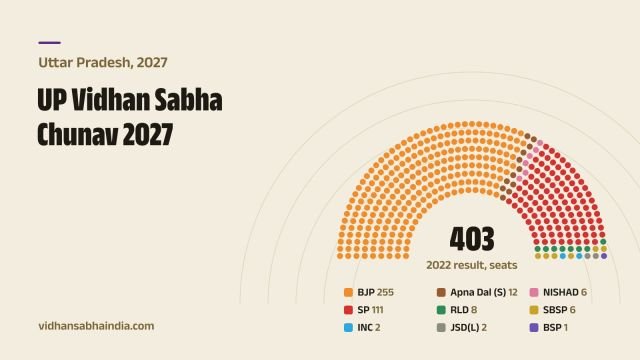
- Largest: Uttar Pradesh, 403 seats. Smallest: Puducherry, 30 seats.
Who sits in it
Members of the Legislative Assembly (MLAs) are elected directly by voters, one from each assembly constituency, under the first-past-the-post system: the candidate with the most votes wins, even without a majority.
Article 170 says an assembly must have no fewer than 60 and no more than 500 members. Smaller states are allowed fewer under special provisions — Sikkim has 32, and Goa and Mizoram have 40 each. Some constituencies are reserved for candidates from Scheduled Castes and Scheduled Tribes, in proportion to their population in the state (Article 332).
To be an MLA, a person must be a citizen of India and at least 25 years old (Article 173), and must not hold an office of profit under the government or be disqualified under law.
How long it lasts
An assembly continues for five years from the date of its first meeting (Article 172). It can be dissolved earlier by the Governor, usually on the advice of the Chief Minister, or during President’s Rule. During a national emergency, Parliament can extend its life by up to a year at a time.
That five-year clock is why election dates are tied to each state. Uttar Pradesh’s current assembly, for example, ends on 22 May 2027, so a new one must be elected before then.
Sessions and the people who run them
- The Governor summons and prorogues the house, and there cannot be a gap of more than six months between two sessions (Article 174).
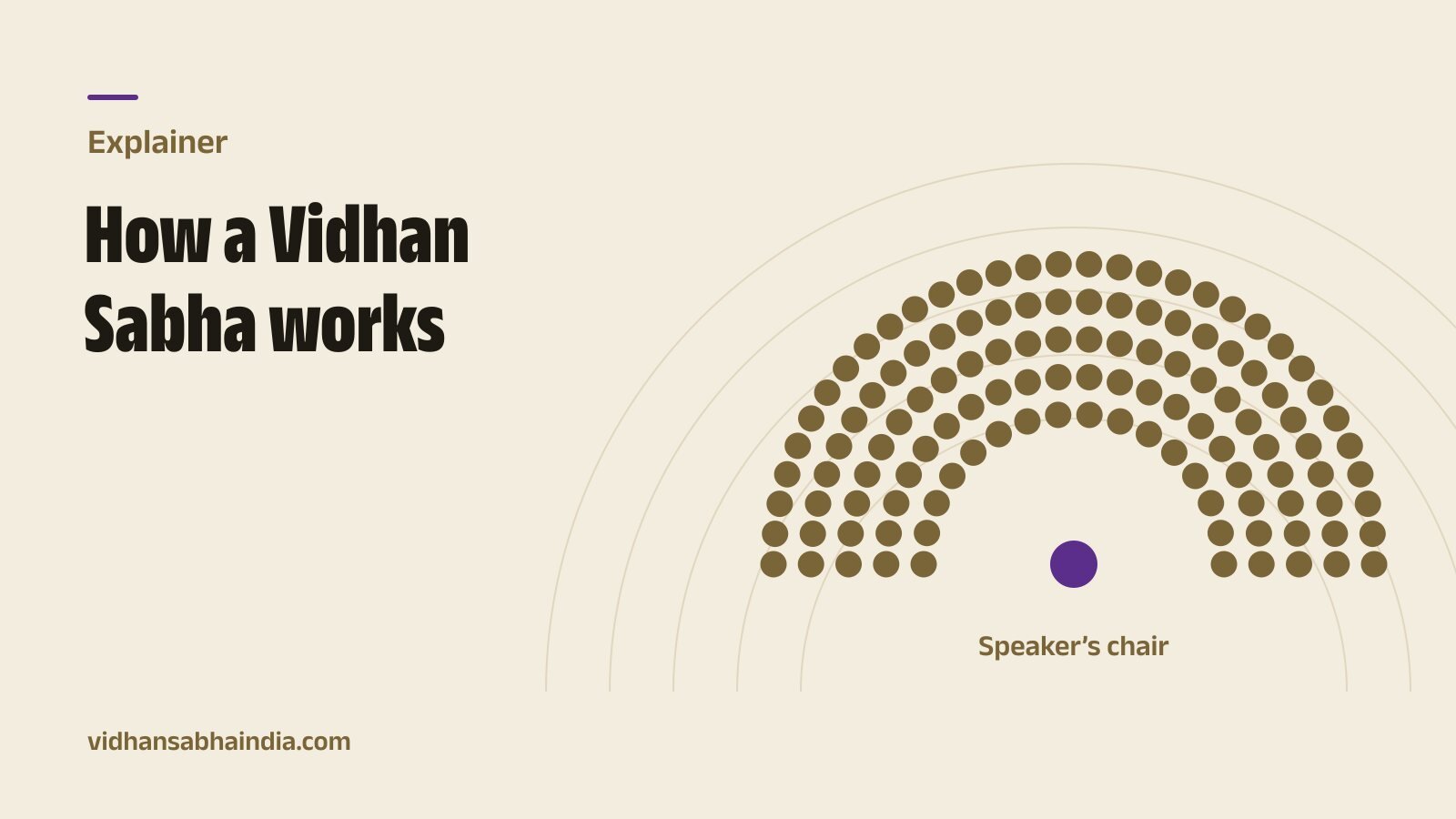
- The Speaker is elected by the MLAs from among themselves and presides over the house, along with a Deputy Speaker (Article 178). The Speaker decides who may speak, rules on points of order, certifies money bills and decides disqualification petitions under the anti-defection law.
- Quorum — the minimum attendance for business — is ten members or one-tenth of the house, whichever is greater (Article 189).
- The Leader of the Opposition is usually the leader of the largest party not in government.
How a government is formed
After an election, the Governor invites the leader who appears to command a majority to become Chief Minister. The Chief Minister then recommends the other ministers (Article 164). The council of ministers is collectively responsible to the assembly: if it loses a confidence vote or a no-confidence motion succeeds, it must resign.
Since the 91st Amendment of 2003, the council of ministers cannot exceed 15% of the assembly’s strength, though it must have at least 12 members.
How a bill becomes law
- Introduction: a minister (or, less often, a private member) introduces the bill.
- Readings and debate: the house discusses the bill, may send it to a committee, and votes on it clause by clause.
- Passing: the bill passes with a majority of members present and voting.
- Council (if any): in a bicameral state, the bill goes to the Vidhan Parishad, which can delay but not ultimately block it (see below).
- Assent: the Governor may give assent, withhold it, return the bill for reconsideration, or reserve it for the President (Article 200).
Money bills
Taxes, borrowing and spending are controlled by the Vidhan Sabha alone. A money bill can be introduced only in the assembly and only on the Governor’s recommendation. If the state has a council, it must return the bill within 14 days, and the assembly is free to ignore its suggestions (Articles 198–199). This is why only the directly elected house can make or break a government.
Vidhan Sabha and Vidhan Parishad
Six states have a second house, the Vidhan Parishad or Legislative Council: Andhra Pradesh, Bihar, Karnataka, Maharashtra, Telangana and Uttar Pradesh.
| Vidhan Sabha (Assembly) | Vidhan Parishad (Council) | |
|---|---|---|
| Exists in | Every state, plus Delhi, J&K and Puducherry | Six states |
| How members are chosen | Direct election by voters | Indirect: by MLAs, local bodies, graduates and teachers, plus nominees of the Governor |
| Size | 60–500 (with exceptions) | At most one-third of the assembly, at least 40 (Article 171) |
| Term | Five years, can be dissolved | Permanent house; one-third of members retire every two years |
| Money bills | Full power | Can only delay for 14 days |
| Ordinary bills | Final say | Can delay up to three months, then one more month if the bill is passed again |
| Government | Council of ministers is responsible to it | No power to remove the government |
A council’s members are chosen roughly as follows: one-third by MLAs, one-third by local bodies such as municipalities and district boards, one-twelfth by graduates, one-twelfth by teachers, and one-sixth nominated by the Governor for expertise in fields such as literature, science, art and social service.
Parliament can create or abolish a council if the state assembly passes a resolution asking for it by a special majority (Article 169).
The anti-defection law
The Tenth Schedule disqualifies an MLA who voluntarily gives up membership of their party or votes against the party whip without permission. There is one major exception: if at least two-thirds of a party’s legislators agree to merge with another party, they are not disqualified. The Speaker decides these cases, and the decisions can be challenged in court. Goa’s assembly saw this exception used in 2019 and 2022 — read how.
Why MLAs matter beyond the state
- They elect the state’s members of the Rajya Sabha.
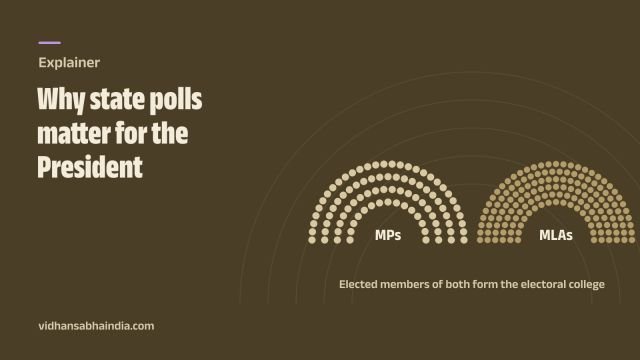
- They form part of the electoral college that elects the President of India. Here is how votes are weighted.
- In bicameral states, they elect one-third of the members of the legislative council.
India’s assemblies by size
| Largest assemblies | Seats | Smallest assemblies | Seats |
|---|---|---|---|
| Uttar Pradesh | 403 | Puducherry | 30 |
| West Bengal | 294 | Sikkim | 32 |
| Maharashtra | 288 | Goa | 40 |
| Bihar | 243 | Mizoram | 40 |
| Tamil Nadu | 234 | Arunachal, Manipur, Meghalaya, Nagaland, Tripura | 60 each |
The full list of all 31 assemblies, with seat counts, is on our homepage directory.